A short link has a longer life than the campaign it was made for. It goes on a flyer, into a podcast description, onto a product box, or into a QR code on a restaurant table. The campaign ends, the budget moves on, and the link keeps getting clicked. Sometimes for months, often for years. That raises a plain question: what happens to those clicks when the service behind the link stops, or when you stop paying for it?

The web forgets faster than you think
In May 2024 the Pew Research Center published a study of what it called digital decay. It looked at webpages collected between 2013 and 2023 and checked which of them could still be reached. Some of its findings:
- 38% of webpages that existed in 2013 were no longer accessible a decade later.
- A quarter of all the pages that existed at some point between 2013 and 2023 were gone as of October 2023.
- 23% of news webpages contained at least one broken link, as did 21% of webpages from government sites.
- 54% of the Wikipedia pages in the sample had at least one link in their references that pointed to a page that no longer exists.
Most of those pages did not vanish because a whole website went down. In most cases a single page was deleted or moved on a site that otherwise kept working. Link rot is not a rare accident. It is what happens to links by default.
A short link adds a second way to fail. The page at the destination can disappear, and so can the redirect in front of it. When the shortener goes away, every QR code you printed and every link you shared points nowhere, even if the page behind it is still there.
When the shortener itself goes away
Two well known link services from Google show how this plays out.
goo.gl. In March 2018 Google announced that it was turning down its URL shortener. People who had never made a short link could no longer create one after April 2018, the console closed in March 2019, and Google said that all existing links would continue to redirect. In July 2024 it changed that plan: goo.gl links would stop responding after August 25, 2025, because more than 99% of them had seen no activity in the past month. In August 2025 it narrowed the shutdown again. Only links that had shown no activity in late 2024 would be deactivated, and links still in use would keep working.
The links that survived were the ones people still clicked. That is the hard part about link rot: nobody knows in advance which link will still matter in five years.
Firebase Dynamic Links. Firebase told developers in 2023 that Dynamic Links was deprecated, and shut the service down on August 25, 2025. Its deprecation notes say that links clicked after the shutdown return an HTTP 404 to the people who click them. That includes links on the custom domains customers had connected.
Both services came from one of the largest companies on the internet, and both ran for years. If a link service from Google can be turned off, a link service from anyone can. What matters is what the service promises for the day it happens.
The quieter way links die
A shutdown is rare. The more common risk is smaller: a link that only works as long as the plan that created it. On some services an expired plan means links stop redirecting, start showing an interstitial page, or lose the custom domain they were published on. Nothing has shut down, and the QR code on your packaging still leads nowhere.
Your links outlive your interest in them. A link printed on a box today can be scanned by someone who finds that box in a drawer years from now. The redirect should not depend on whether your card was renewed last month.
What MouseURL promises
We wrote this into our Terms of Service, not only onto a marketing page, because a promise about links is only worth what the terms say.
- Stop paying and your links keep redirecting. The workspace moves to Nibble, the free plan, and every link you published keeps working, even if the workspace is over the Nibble limits. Nothing you published is deleted because a plan ended.
- A redirect ends only for a reason you can see. You disable or delete the link, it reaches an expiry date you set, it breaks the terms or a legal order requires its removal, or it lives on your custom domain and that domain's DNS no longer points to us.
- If MouseURL ever stops operating, we announce it by email to every workspace owner and on mouseurl.com, and from that day we take no new sign-ups and no renewals. The service and every redirect keep running until the last paid period of each workspace ends, and in every case for at least 6 months after the announcement. Nothing is refunded, because no paid period is cut short. On the day the service ends for a workspace, we email its owner the workspace's links, bio pages, and analytics as CSV files, with our thanks.
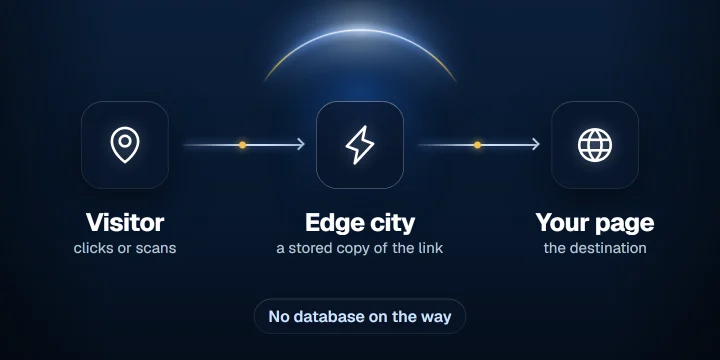
The redirect itself does not depend on the dashboard. Each click is answered at the edge, from a copy of the link stored there:
Own the part that matters: the domain
The best protection against any shortener going away is a domain you own. MouseURL lets you put your short links on your own domain, and when they live on go.yourbrand.com, the domain is yours and the shortener is only where it currently points. With an export of your links and their destinations, you can point that domain somewhere else and recreate the redirects. The printed QR codes keep working because they never named the shortener at all.
Links on a shortener's own domain cannot move that way, however good the export is. That is why MouseURL lets you export your links as a CSV file at any time, and why custom domains are part of every paid plan, starting with Whisker. The same domain can carry your link in bio page too, built from one of the free bio templates.
Five questions to ask any shortener
Before you print a short link, it is worth asking where it will be in five years.
- What happens to my links if I stop paying? Look for the answer in the terms, not only in a FAQ.
- What happens to my links if the company shuts down? Is there a notice period, and do I get my data?
- Can I put my links on my own domain?
- Can I export every link with its destination, whenever I want?
- Can I change where a link goes after it has been printed, without making a new QR code?
A short link is a small promise to whoever clicks it, sometimes years after you made it. We built MouseURL so that promise does not depend on your next invoice.
Frequently asked questions
Do MouseURL links stop working if I cancel my plan?
No. The workspace moves to Nibble, the free plan, and every link you published keeps redirecting, even if the workspace is over the Nibble limits. The Terms of Service put this in writing.
What happens to my links if MouseURL shuts down?
We announce it by email and on mouseurl.com and stop new sign-ups and renewals. Every redirect keeps running until the last paid period of each workspace ends, and for at least 6 months in every case. Each workspace owner then gets the links, bio pages, and analytics as CSV files.
Can I move my short links to another service later?
Yes, if they live on your own domain. Export your links as a CSV file, point the domain at the new service, and recreate the redirects there. Links on a shortener's own domain cannot move that way.
Why can a short link break even when its page still exists?
Because the redirect in front of the page can go away on its own. If the shortener shuts down or stops serving the link, every click lands nowhere, even though the page behind it is still online.
Sources
- Pew Research Center, When Online Content Disappears, May 17, 2024.
- Google Developers Blog, Transitioning Google URL Shortener to Firebase Dynamic Links, March 30, 2018.
- Google Developers Blog, Google URL Shortener links will no longer be available, July 18, 2024.
- Google, We're updating our plans for goo.gl links, August 1, 2025.
- Firebase, Dynamic Links Deprecation FAQ.